What is the Emotional Freedom Techniques?
The Emotional Freedom Techniques, or EFT, is the psychological acupressure technique I routinely use in my practice and most highly recommend to optimize your emotional health. Although it is still often overlooked, emotional health is absolutely essential to your physical health and healing — no matter how devoted you are to the proper diet and lifestyle, you will not achieve your body's ideal healing and preventative powers if emotional barriers stand in your way.
EFT is very easy to learn, and will help you:

- Remove Negative Emotions
- Reduce Food Cravings
- Reduce or Eliminate Pain
- Implement Positive Goals
EFT is a form of psychological acupressure, based on the same energy meridians used in traditional acupuncture to treat physical and emotional ailments for over 5,000 years, but without the invasiveness of needles. Instead, simple tapping with the fingertips is used to input kinetic energy onto specific meridians on the head and chest while you think about your specific problem — whether it is a traumatic event, an addiction, pain, etc. — and voice positive affirmations.
This combination of tapping the energy meridians and voicing positive affirmation works to clear the "short-circuit" — the emotional block — from your body's bioenergy system, thus restoring your mind and body's balance, which is essential for optimal health and the healing of physical disease.
Some people are initially wary of these principles that EFT is based on — the electromagnetic energy that flows through the body and regulates our health is only recently becoming recognized in the West. Others are initially taken aback by (and sometimes amused by) the EFT tapping and affirmation methodology, whose basics you will learn here.
But keep in mind that, more than any traditional or alternative method I have used
or researched, EFT works. I have witnessed the results in my patients since deciding
to use EFT exclusively in June of 2001. Indeed, because of its very high rate of
success, the use of EFT has spread rapidly, and
medical practitioners employing EFT can now be found in every corner of
the country and the world.
This manual will provide an overview on how and where to tap, and the proper affirmation techniques, so that you can begin using EFT immediately to help yourself and others. It will also provide an introduction to some advanced EFT strategies and principles you can employ.
Tapping Locations and Technique
There are two basic areas to learn in order to use EFT: the tapping locations and technique, and the positive affirmations. These areas, as well as some advanced EFT guidelines and principles, are covered in the following sections.
You should be able to successfully treat many problems by diligently applying the
following instructions.
If you are not getting the results you would like, or you have a particularly traumatic
issue, please do not give up! Instead, consider consulting with an EFT professional.
You may check out this clinical EFT-certified practitioner database for some guidelines
on selecting an EFT therapist, and to find a list of EFT practitioners throughout
the U.S. and the world. Many of these therapists even offer a free 15-minute phone
session in which you can ask them questions to see if you connect.
Proper EFT Tapping
The basic EFT sequence is straightforward and generally takes my patients only a
few minutes to learn. They have the slight advantage of me personally showing them
the tapping points, but you should be able to pick up these points relatively quickly.
With a little practice, you will be performing each round in under a minute.
NOTE: While it is important to tap the correct area, you need not worry about being
absolutely precise, as tapping the general area is sufficient.
It's All in the Fingertips
The first thing to understand is that you will be tapping with your fingers. There
are a number of acupuncture meridians on your fingertips, and when you tap with
your fingertips you are also likely using not only the meridians you are tapping
on, but also the ones on your fingers.
Traditional EFT has you tapping with the fingertips of your index finger and middle
finger and with only one hand. Either hand works just as well. Most of the tapping
points exist on either side of the body, so it doesn't matter which side you use,
nor does it matter if you switch sides during the tapping. For example, you can
tap under your right eye and, later in the tapping, under your left arm.
I modified this approach slightly by having you use both hands and all your fingers,
so that they are gently relaxed and form a slightly curved natural line. The use
of more fingers allows you to access more of the acupuncture points. When you use
all your fingers you will cover a larger area than just tapping with one or two
fingertips, and this will allow you to cover the tapping points more easily.
However, many obtain quite successful results with the traditional one-handed two-finger
approach. You can use either method, but I tend to use my modified version in an
effort to be more complete.
Ideally, you will want to use your fingertips, not your finger pads as they have
more meridian points. However, if you have long fingernails you should use your
finger pads.
You should also remove your watch and bracelets, as that will interfere with your
use of the wrist meridian tapping.
Tap Solidly — But Don’t Hurt Yourself!
You should tap solidly, but never so hard as to hurt or bruise yourself.
If you decide to use both hands, I recommend slightly alternating the tapping so that each hand is slightly out of phase with the other and you are not tapping with both hands simultaneously. This provides a kinesthetic variant of the alternating eye movement work that is done in EMDR and may have some slight additional benefit.
When you tap on the points outlined below, you will tap about five to seven times. The actual number is not critical, but ideally should be about the length of time it takes for one full breath. There is probably a distinct benefit for tapping through one complete respiration cycle.
Please notice that these tapping points proceed down the body. That is, each tapping
point is below the one before it. That should make it a snap to memorize. A few
trips through it and it should be yours forever. However, unlike TFT, the sequence
is not critical. You can tap the points in any order and sequence, just so long
as all the points are covered. It just is easier to go from top to bottom to make
sure you remember to do them all.
Remove Your Glasses and Watch Prior to Tapping
Glasses and watches can mechanically and electromagnetically interfere with EF,
so I advise everyone to remove them prior to tapping. For quick sessions conducted
upon yourself, this is not critical, as you can easily tap around them, but I think
there is always a benefit to removing them when possible.
Using EFT in Public: Eliminating Any Embarrassment
Many people are concerned about embarrassing themselves by using EFT in public,
especially when implementing my revision of it, which really makes one stand out
in a crowd.
After a while of using and perfecting the technique — in private quarters, if you prefer — you will be able to use only two fingers of one hand, and to say the affirmation softly under your breath or silently. This way you can do EFT in just about any social setting, and if people even notice what you are doing at all, it will appear to them that you are merely thinking.
Finding the Right Tapping Points
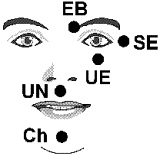
The tapping points, and their abbreviations, are explained below, followed by a
chart of the points. They are presented below in the exact order in which they should
be tapped.
The abbreviations for these points are summarized below in the same order as given
above. It is, again, the order in which they should be tapped:
|
TH = Top of Head
EB = Eye Brow
SE = Side of the Eye
UE = Under the Eye
UN = Under the Nose
Ch = Chin
CB = Collar Bone
UA = Under the Arm
WR = Wrists
|
Using EFT's Affirmation Statements
Tuning Into Your Problem
Now that you understand how to actually perform the mechanical tapping and where
you need to tap, you will next need to know what to say while you are tapping.
The traditional EFT phrase uses the following setup:
"Even though I have this _____________,
I deeply and completely accept myself."
You can also substitute this as the second part of the phrase:
"I deeply and completely love and accept myself."
The blank above is filled in with a brief description of the addiction, food craving,
negative emotion or other problem you want to address.
Examples Using the Traditional EFT Phrasing
While these examples represent a range of problems, keep in mind there really is no limit to the types of issues you can confront with EFT:
"Even though I have this fear of public speaking, I deeply and completely accept
myself."
"Even though I have this headache, I deeply and completely accept myself."
"Even though I have this anger towards my father, I deeply and completely accept
myself."
"Even though I have this war memory, I deeply and completely accept myself."
"Even though I have this stiffness in my neck, I deeply and completely accept
myself."
"Even though I have these nightmares, I deeply and completely accept myself."
"Even though I have this craving for alcohol, I deeply and completely accept
myself."
"Even though I have this fear of snakes, I deeply and completely accept myself."
"Even though I have this depression, I deeply and completely accept myself."
Other EFT Phrase Options
You can also try these other phrase variations. All of these affirmations are correct
because they follow the same general format. That is... they acknowledge the
problem and create self-acceptance despite the existence of the problem.
That is what's necessary for the affirmation to be effective.
You can use any of them, but I suggest you use the recommended one above because
it is easy to memorize and has a good track record at getting the job done.
"I accept myself even though I have this_________."
Or:
"Even though I have this ____________, I deeply and profoundly accept myself."
OR:
"I love and accept myself even though I have this_______________."
Interesting Points About the Affirmation Statements
It doesn't matter whether you believe the affirmation or not... just say it.
It is better to say it with feeling and emphasis, but saying it routinely will usually
do the job.
It is best to say it out loud, but if you are in a social situation where you prefer
to mutter it under your breath... or do it silently... then go ahead. It will still
likely be effective.
To add to the effectiveness of the affirmation, The Setup also includes the simultaneous
tapping on one of the acupuncture meridian points.
Tuning in is seemingly a very simple process. You merely think about the problem
while applying the tapping. That's it... at least in theory.
"The cause of all negative emotions is a disruption in the body's energy system."
Negative emotions come about because you are tuned in to certain thoughts or circumstances,
which in turn, cause your energy system to disrupt.
Otherwise, you function normally. One's fear of heights is not present, for example,
while one is reading the comic section of the Sunday newspaper and therefore not
tuned in to the problem.
Tuning in to a problem can be done by simply thinking about it. In fact, tuning
in means thinking about it.
Thinking about the problem will bring about the energy disruptions involved which
then... and only then... can be balanced by applying The Basic Recipe.
Without tuning in to the problem, thereby creating those energy disruptions, EFT
does nothing.
Putting It All Together First Round of Tapping
Now you will need to tap on each of the points described above while you are stating
the positive affirmation. This will only take a few moments to do.
You should:
- Select an appropriate affirmation
- Carefully "tune in" to your problem by actually trying to hold the problem in your
thought
- State the affirmations in a loud voice with great passion, energy and enthusiasm
If you do this while tapping the points described earlier, it is highly likely you
will notice a major decrease in the issue or problem that you were tapping on. If
your problem or issue resolves completely, you are done with the tapping.
Tips and Tricks for Using Advanced Affirmation Statements: The 7-Part EFT Manual
Using the Reminder Phrase
Sometimes, one round of the tapping sequence while voicing your affirmation is enough
to clear up the issue. However, when subsequent rounds are necessary, you can employ
a "reminder phrase." This is simply a word or short phrase that describes the problem
and which you repeat out loud each time you tap one of the points in the sequence.
In this way you continually "remind" your system about the problem you are working
on.
The best reminder phrase to use is usually identical to what you choose for the
affirmation you initially used. However, you can use a shortcut if the setup is
particularly long by simply saying one or several words to speed up the process
and do more rounds.
For example, if you are working on a fear of public speaking, the initial, or "setup,"
affirmation would go like this:
"Even though I have this fear of public speaking,
I deeply and completely accept myself."
Within this affirmation, the underlined words "fear of public speaking" are ideal
candidates for use as the reminder phrase. Simply repeating this reminder phrase
and the affirmation are usually sufficient to "tune in" to the problem at hand.
Lingering Issues: Adjustments for Subsequent Rounds of Tapping
Sometimes the first round of tapping doesn't completely eliminate a problem because a new issue or issues that prevent further progress show themselves via the tapping. These issues — whether images, conversations, interactions or in some other form — are in some way related to the first problem being addressed — sometimes they are part of or the core of the cause, sometimes they are a result. The barrier restricting your emotional health, in other words, is made up of more than one brick — and you must eliminate all the bricks.
If this is the case, you should do additional rounds of tapping as necessary to
eliminate all the issues, but adjust your affirmation slightly as follows for best
results:
"Even though I still have some of this __________,
I deeply and completely accept myself."
Note the words "still" and "some" and how they change the thrust of the affirmation
toward the remainder of the problem.
EFT Cautions and Advice
Clinicians and clients should only do what feels right or good to them. You should
not enter into emotional or physical waters that seem threatening. It is your responsibility
to take care of yourselves in this setting. Remember professional help is easily
available. Here are some cautions and advice with EFT:
-
Be Specific
It is essential for clinicians to be extremely specific with language when using
EFT.
-
Tuning In
The clients need to be totally tuned in to the issue of concern when using EFT.
Sometimes, when the material is emotionally painful, clients will want to disconnect
from their feelings. Look for any signs that the client is becoming distracted or
disengaged and make sure that they repeat the Reminder Phrase as they tap the treatment
points.
-
Cognitive Shifts
As with energy movement, it is essential to pay attention to the cognitive shifts
that can occur with even a single round of the tapping. A cognitive shift has occurred
when you reframe the problem. Seeing the problem from a new angle, you will often
express a sense of surprise and insight. These movements can offer valuable connections
and associations and may open new pathways for healing. Following a cognitive shift,
you often feel less guilt and self-blame, more hope, or a simple sense of relief
in an area where there has never been relief before.
It is important to stop after tapping and see if you notice anything different or
if something new came up after you tapped. This is frequently the underlying issue
that is the real root of your problem.
-
Energy and Intention
Many clients report that they do not have the same success when using EFT by themselves
and on themselves. This likely has to do, in part, with the advantage of combining
the energy and intention of two people sharing a single purpose during a session.
When clients are less than satisfied with their own results, it is best to find
a therapist to help them resolve the issue at a deeper level.
-
Through Me, Not By Me
This is one of Gary Craig's other favorite sayings. EFT practitioners are NOT healing
their clients. The healing is done through us if our clients are open to receive
it.
Many people see themselves as special healers. This, in fact, interferes with the
treatment process. The reality is that they are not healing anybody; the clients
are actually healing themselves. Witnessing and facilitating this process is humbling
as well as gratifying.
-
Keep Well Hydrated
Water conducts electricity, and EFT accesses the electrical energy that flows through
our bodies and minds. It is very important for both you and your clients to be properly
hydrated. That would be about one quart of pure water per day for every 50 pounds
of body weight.
Practice Your Affirmation Statements with Timing and Mirror Work
More On Your Affirmations
Doing affirmations is one of the best ways to be kind to your mind, every thought
you have, every sentence you speak is an affirmation of a sort. It is either positive
or negative. However, you can also do specific intentional affirmations. And the
beautiful thing about doing affirmations is that you can radically improve the effectiveness
with EFT.
You can do this by first creating a definite positive statement that builds you
up instead of beats you up. We're talking about definite positive statements to
make or do, something in our lives or to create a specific goal.
You can start this process with positive self-statements. Even if it doesn't feel
true to begin with, you will want to do these statements or affirmations many times
a day.
Timing of Your Affirmations
When you wake up, when you go to bed, every time you go to the bathroom you should say them.
It is especially important to tap and say the affirmations before you go to sleep. This is probably the single most important time to do it. I can't encourage you enough to do the EFT affirmations every night. It is one of the most important principles I can give you. When you tap before you go to bed you will give your subconscious from six to eight hours to work on your affirmations and help create them for you.
If you find prayer a helpful resource like I do, you will want to integrate your
prayer into the EFT sequences as I believe that will help dramatically increase
the effectiveness of your affirmations.
It took me a nearly a year after learning EFT before I got in the habit of tapping
before going to bed, but I want you to avoid my mistake and not wait awhile before
you start doing this valuable technique. Start tapping each and every night before
you go to bed.
Mirror Work
This is actually quite simple and inexpensive; all you need is a mirror and some
time. You can certainly tap alone or in the dark, but I find it is far more effective
to tap while staring at your own eyes, in the mirror. This seems to provide a far
deeper connection with your subconscious. It's almost as if the mirror is reflecting
back your energy into you rather than going out into space somewhere.
If you haven't tried this yet you really need to consider doing this profoundly
simple yet powerful technique.
You can begin by looking in the mirror and doing your EFT affirmations and you can
tap that in on all the EFT points. Pay careful attention and listen to what you
hear, especially focusing on any negative messages that can be blocking your progress.
You may not get any messages initially because you are so used to beating yourself up and you are not used to a kind loving thought, but listen and follow through and learn to trust yourself.
We frequently have a tendency to beat ourselves up for every little thing no matter
how small. All of us can use forgiveness on a daily basis and you can use the mirror
to help you here also.
You can start by looking into your own eyes and say, "Even though I wasn't successful or I was angry or impatient or mean or cruel," or whatever problem you need to forgive yourself for then say, "I forgive you, I was only doing the best I could."
I forgive you for holding onto those patterns for too long, I forgive you for not loving yourself.""
And when you say "you," you are looking directly into your own eyes.
You have to try this as it is quite powerful. Remember to always acknowledge the
negative thought if it is there, but don't give it a lot of importance.
Then you will want to use EFT on the negative thought that comes up and create a
positive opposite.
The Real Reason Why You Can't Achieve Your Goal Or Lose Weight
A very common occurrence that will present itself is when you start to tap for a food craving, you will have a memory of an image, person, place or event that the craving reminds you of. When you are doing the tapping sequences, you will want to pay special attention to these usually negative thoughts or images that come up. Carefully listen for any statements that your subconscious is telling you are not right or true for you.
This is writing on your wall and causing a psycho-energetic block, and unless you address that reversal is not going to allow you to progress forward. This is usually the major challenge for you and one of the primary reasons as to why you have been able to successfully implement your goal in the past. Unless you directly address this issue by some means, it invariably will self-sabotage your efforts to achieve your weight loss goal.
Fortunately the solution is quite straightforward with EFT, you simply acknowledge
whatever self-critical thoughts, images or feelings come up and then chose to simply
love and accept yourself while taping on your acupuncture meridians.
Do this persistently and eventually your system will improve with time. Remember
to say your statements with great enthusiasm and all the emotions you can muster.
Your subconscious mind will not convert your affirmations into reality unless you
can tie the statements in with emotional energy.
Let me provide a few examples to more fully illustrate my point. When I once gave an EFT demonstration in front of 400 clinical nutritionists and I had a volunteer come up who had a food craving. It turns out the physician who volunteered had a craving for Rice Krispy treats that were in the exhibit area. Her craving was a strong 10. As soon as we did one round of tapping, her eyes started to water and she was on the verge of tears. When I explored the issue further with her, she said that she was reminded of the time when her mother would give her M&M’s treats to get her out of her hair.
So the real issue had nothing to do with her craving for the treats but it was the
love and attention that her mother did not give her and the clearly inferior candy
substitute that her mother offered her. We tapped on that issue and her cravings
for the sweets disappeared instantly.
Another example would be a woman I saw who was 64 years old and was having trouble
losing weight. When we started the EFT affirmation sequence, she had a memory of
how the last time she was her normal goal weight she was pregnant. Even though consciously
she very well knew that short of a miracle, she was not going to become pregnant
at 64, she was blocked from going forward with her weight loss. Her subconscious
was convinced that if she achieved her goal weight she would instantly and immediately
become pregnant.
Fortunately, we were able to use EFT to bridge the gap to the subconscious and connect
it back to reality. Once we completed tapping that issue through, she was able to
successfully lose the 22 pounds of weight she had been unable to do for over 20
years.
This is a very powerful illustration that the subconscious is absolutely neutral. Remember your subconscious is your faithful servant and it will provide you with exactly what you tell it. It couldn’t care less whatever demand you place on it. In many ways it is like your computer. It will perform whatever instructions you tell it. So you must be very careful of the instructions you provide.
The above story illustrates a negative example of the power of the subconscious,
but you could just as easily implant positive affirmations and your subconscious
will just as reliably provide you with that result in your life. I offer some practical
suggestions on how to take advantage of this principle below.
Be Persistent With Your Affirmations
When you first say an affirmation, it may not seem to be true. Please remember that
affirmations are like planting seeds in the ground. It helps if you think of our
mind like a garden in which your thoughts are seeds that you are planting. When
you do these affirmations, it is like putting a new seed into the ground.
Remember when you plant a seed in the ground, you only have a little tiny seed,
you don't have a full-grown plant. That little seed needs to germinate. Then it
breaks open its little shell and it starts to get nourishment from the earth. Then
first the roots come out and then and only then does that first little shoot come
out through the ground.
Just like it takes some time to go from seed to a full-grown plant, it takes some
time from your first affirmation to the realization of your goal. It doesn't matter
whether you see the results or you don't see them. You have to trust that it just
takes time.
What Can You Do When Your Inevitable Fear Thoughts Come Up
When a fear thought comes up, simply say thanks for sharing, thank you for protecting
me. Do not give it power. Don't run from it. Whatever comes up, it is very important
to acknowledge it, when you hear them you can even write them down.
Once you have written the fear thought down, you can turn it around to a positive affirmation and tap it in with EFT. You can say, "even though I have this fear (name the fear), I deeply love and accept myself and I fully appreciate that it is only trying to help me."
Then do an affirmation for what you really want, which is typically the positive
present tense opposite of the fear, or whatever positive outcome you would desire
instead of the fear.
Avoid denying the fear. You always want to acknowledge the fear. That is the real
beauty of EFT, it always acknowledges the truth and helps you get out of the denial
trap that so many of us fall into.
EFT helps you understand that your fear thought is there to protect you. That is
what fear really is for, to protect us.
It is important to recognize that no matter where you are in life, no matter what
you contributed to creating, no matter what is happening, you are always doing the
best you can with the understanding, awareness, and knowledge that you have until
you can find a better way to handle the situation.
Be Patient With Your Affirmations
A critical truth that is helpful to remember when doing this work is that your persistent
and consistent thoughts will eventually become your reality so be careful to only
focus on positive thoughts.
So many people do EFT affirmations for a few days, they say it doesn't work and
they stop. Remember, everything happens in a perfect time space sequence. You want
to trust that and we want to know that.
Fortunately, EFT seems to rapidly accelerate not only the time at which your goal
is realized, but the likelihood for your success. From my experience it is one of
the most profoundly effective ways to maximize the success of your affirmations.
Be Present With Your Affirmations
Be sure to always remember to say your positive statements in the present tense. Your subconscious mind is very literal and if you ask it to do something in the future, you may fail to achieve your goals for many long years.
So many of us commonly default to this by force of habit. It takes quite a bit of
conscious effort to avoid this non-intentional self-defeating trap. So always avoid
saying I will have or I am going to have, which is in the future tense.
Always say your affirmation in the present tense, otherwise you run the serious risk of delay of you obtaining what you want and you may never get it.
Importance of Using Self-Affirmation Principle
When I first started doing the EFT work, I immediately modified the affirmation response and tried substituting phrases like, “I chose to remain calm and relaxed,” and a variety of other ones that I thought might be better.
However, the more I studied this issue, the more I realized that self-love is at
the core of the problem with most of our issues.
Everyone Knows What the Golden Rule Is
To do unto others, as you would have them do unto you.
It is very hard to love your neighbor if you don't love yourself.
Now when I talk about loving yourself I'm not talking about vanity or arrogance
but talking about really respecting and cherishing the incredible miracle that you
really are.
You cannot harm yourself, or you cannot harm another person if you love yourself.
Unconditional acceptance is one of the major goals that we are here for and that
begins with self-acceptance and self-love.
The number one thing we can do to help us love ourselves, especially if we are going
to lose weight is stop ALL criticism. We need to stop criticizing ourselves now
and forever, never again if we are going to make forward progress. We need to vow
to ourselves to never criticize ourselves ever again.
Most of us have been criticizing ourselves and beating ourselves up for years. We
are not going to make much forward progress if we persist in this pattern.
When we criticize ourselves we contribute to negative changes and when we approve
of ourselves we facilitate positive changes. Our thoughts create and contribute
to all of our experiences in life, especially related to health issues.
You have complete control over our thoughts, not of your emotions. Choose the thoughts that are nurturing and supportive for you. Criticizing yourself never changes a thing. So please refuse to criticize yourself.
You need to accept yourself exactly the way you are. If you don't love yourself when you are 10, 20, 50 or over 100 pounds overweight, it will be highly unlikely that you will love yourself at your "ideal" weight. Self-acceptance is the critical key here.
You can use the EFT affirmations to help you address the central core that seems
to be at the key to most people's health problems, which is loving yourself and
a peaceful transformation of your self-criticism.
Everyone has made negative choices in the past, we all have. The good news is that
we all have a choice. You can always choose to let go of the old pattern. You can
choose different and more supportive and nourishing thoughts. Letting go of your
old negative pattern with love, allows you to move into the new pattern with ease.
Please always avoid punishing yourself and beating yourself up.
Forgiveness
This is one of the keys to being successful with EFT, and forgiving others is every bit as important as forgiving ourselves. Not forgiving them does not harm them in the slightest bit, but it plays havoc with us. Because the issues are not theirs, they are ours.
People who have problems loving themselves always seem to have problems learning to forgive others. Non-forgiveness shuts that door. But when you forgive and when you let go, not only does a huge weight drop off from you, and the doorway to your own self-love opens up.
When you won't forgive, when you won't let go, what you are really doing is binding yourself to the past and when you are stuck in the past you cannot live in present time. And if you cannot live in present time, how are you going to create a healthy and exciting future?
And that is the absolutely wonderful and powerful feature of EFT is that it allows you to effectively forgive someone. I have used EFT for hundreds of people to help them forgive at the deep subconscious level.
Not just in your head, but in your heart, where it really counts.
Your Language
I certainly have noticed this with many people I have worked with. It all starts
with our self-talk. Our self-talk or the way we talk to ourselves becomes important
because it becomes the basis of our spoken word.
It sets up the mental atmosphere that we operate in. This will attract to us experiences.
You see your subconscious is really an electromagnetic transmitter and receiver.
It broadcasts emotions in space and whatever we broadcast we tend to receive from
our environment.
BE VERY CAREFUL WITH YOUR LANGUAGE
You see much of your power is in your words. The thoughts you think and the words
you say are constantly creating your future. Your beliefs shape your life. The things
you say are extension of your thoughts. This is why it is so important to never,
ever berate yourself.
Always tell yourself you are doing the best you can.
If all you do is tell yourself you are fat and ugly and you hate yourself this way,
then you stay stuck. You need loving support and then you can make changes. You
need to constantly forgive yourself for not being perfect.
Too many of us think we have to be bad or wrong before we can be changed but we
really don't have to do that. When you come from love and acceptance the changes
can become much easier. You make a change because you want to improve the quality
of our life, not because you are a bad person that wants to become better.
And when you know more you will do things differently, so never, ever berate yourself
for where you were.
Just tap in, "I'm doing the best I can, I'm doing the best I can."
Remember, you need to constantly forgive yourself for not being perfect.
Do EFT About 10 Times Per Day
This will allow you to obtain maximum benefit from the technique.
It will also be enormously helpful if you can do this in front of a mirror, paying careful attention to looking into your eyes. Your energy will be reflected off the mirror and add a profound synergism to the EFT tapping.
When in public, you only need to use one hand that can lightly touch each point and hold it there for five seconds while "tuning into the problem" and repeating the affirmation. This way no one will realize what you are doing.
Alternative Approaches and Final Recommendations
Choices Alternative
Dr. Patricia Carrington has made a major innovation to EFT with her choices option.
Unlike the traditional affirmations mentioned above, choices do not contradict a person's present view of reality and so are much more easily accepted. Additionally, they represent a proactive stance and a commitment to one's self.
When using the choices option, a self-acceptance affirmation is substituted for the traditional EFT affirmation used above. In general this affirmation is the opposite of whatever the negative statement contained in the first portion of the Set-Up phrase.
This choice is an expression of what the person truly desires for the problem that
the treatment is presently addressing. It is aimed at that specific problem rather
than being a general affirmation.
Choices Technique
Identify the negative emotion or state (thought, attitude, feeling, pain, etc.) that you want to be rid of.
Formulate a choice that is roughly the opposite of this negative emotion or state.
Combine the negative emotion with the positive choice.
State the entire Basic recipe combination (negative emotion and choice) on the first
three meridian points.
Then alternate the points by stating the negative reminder phrase on one point and
then the positive choice or reminder choice on the next point.
Be careful to always end on a positive choice.
Wording of Choices
Most people do not know how to identify what they really want. Ironically, however, they are almost always very clear about what they don't want.
When asked to make a positive choice, which is based on what they do want, most
people will at best, just choose to improve a bit on what they don't like. One way
they do this is to revert to comparisons.
They will use such words as better or more.
Examples include:
- I choose to be more confident.
- I chose to feel better.
This does not work well because a person's subconscious, computer-like mind is quite
literal and it cannot interpret that statement with any precision. What is better?
It could be only a tiny bit better. How much is more? When this is not spelled out
precisely you have an unclear choice that will not be very effective.
First Rule of Choices: Be Specific
A person making a choice needs to state precisely what it is they want. A choice
should not contain vague comparison words such as "better," but should be a statement
of exactly what they really want to create in their life.
Second Rule of Choices: Create a Pulling Choice
Choices must "pull" to be effective. This requirement is often neglected. A choice
that is lifeless is like a dull ad; you just skip over it, don't attend to it, and
it has very little impact on your life.
You might think of a choice as a sort of ad made up by you and directed to yourself
as a consumer. The person who must be sold is you. You have to buy into and truly
want the manifestation you are trying to bring about.
Whenever possible seek to carefully add an adjective or adjectives to make the choice
as appealing as possible. The aim is to draw you like a magnet toward the goal they
seek. Repeating the choice during the EFT session should be a source of real pleasure
and comfort so that you really want to keep saying the choice over and over simply
because it is so enjoyable to do so.
Examples:
- Let it be easy to ...
- Surprise myself by ...
- Find a creative way to ...
- Find it fun to ...
Alternatively you can add any of these adjectives to give it more appeal:
- Comfortable
- Satisfying
- Delightful
- Ingenious
- Safe
- Unexpected
Third Rule of Choices: Go for the Best Possible Outcome
The rule of thumb here is to be inwardly "truthful" in what is asked for. You need to choose what you really want in your innermost self, not what you think you should want — and it should be the very best you can imagine having.
Examples:
It is not enough to choose to have a "new apartment," because a "new apartment" might be a dingy 6th story walk-up with poor heating, tiny rooms, etc. Yet technically it might be "new" for you. A much more effective choice would be to state exactly what you really want, such as "I choose to live in a quiet, sunny, delightful apartment.”
The more positive and specific you are the better the choice will be.
Fourth Rule of Choices: State Your Choice in the Positive
Those who have worked with affirmations know that the literalness of the computer-mind
makes negative words or phrases a large problem. Our mind tends to ignore the negative
and we get exactly what we were hoping to avoid.
We are always better off being as positive as we can when framing any sort of command to ourselves — and affirmations are basically commands.
When making a choice therefore you should avoid using such negative words and phrases
as:
- No
- Not
- Never
- Don't
- Be rid of
For example:
- Poor Way: I want to be rid of my headache.
- Better Way: I choose to feel clear headed, healthy, focused and enthusiastic.
Fifth Rule of Choices: Do Not Choose for Others
This rule is important to emphasize because some people will choose other's behavior
as though they had control over other people, which none of us have.
For example:
- I choose to have Mary love me.
- I choose to have the people at work think I'm the best.
- I choose to have Ken understand me.
There are many ways that the above incorrectly worded choices can be reworded so
as to be non-manipulative an ethical in nature.
Preferred:
I choose to feel that Mary loves me. Here the person is making a choice about their
own reaction to Mary, something quite within their control.
The details are less important than the intent when applying this rule. The point
here is not to act as though we were all-powerful in another person's life, but
rather word the choice so as to be as genuinely helpful to them as possible without
imposing your values on them.
Psychological Reversals
The most common reason that psychological reversal does not change is that the affirmation
was not said strongly enough or with enough emphasis. Most people will quietly state
the affirmation I have frequently seen that it was necessary for the client to nearly
shout the statements prior to the reversal shifting.
Criteria-Related Reversals
These are subconscious mechanisms that may be in place and blocking the client's
ability to successfully resolve their reversal:
-
Deservedness
This is the most commonly seen of the criteria-related reversals. Common sense dictates that if a person consciously or unconsciously holds the position that he or she does not deserve to get over a problem, attempts to alleviate the problem will be met with considerable resistance. This reversal is common among trauma survivors, patients, people with eating disorders, and those who have violated closely help personal values and morals.
-
Safety
If the client experiences the problem as affording some level of safety, it will
not easily be resolved. This consideration does not necessarily apply to situations
that are truly unsafe or dangerous. This reversal is common among clients with anxiety-related
conditions and even clients suffering from chronic pain.
-
Possibility/Doubt
Some clients experience deep doubt about their ability to resolve the presenting
problem, for whatever reasons. While doubt by itself does not signal a reversal,
if it is deep enough it will be consistent with a reversal.
-
Permission
In many instances this operates in conjunction with another, such as safety or deservedness.
It is as if the energy system is saying, "I won't allow myself to get over this
problem because it isn't safe to get over it" or "I won't allow myself to over this
problem because I don't deserve to get over it."
-
Deprivation
Especially in the treatment of addictions, the issue of deprivation may serve to
block progress. When this type of reversal is diagnosed, a discussion around this
issue is appropriate.
What to Do When You Are Not Getting Results
Negative beliefs may interfere with EFT, or any energy treatment from working very
effectively.
Some of the more common ones that might need to be treated include:
- I don't believe these treatments will work.
- I believe EFT works, but not for me.
- I doubt that EFT will work.
- Even if EFT does work, I am afraid it won't last.
- I don't trust myself to stay free of these problems from now on.
- I am afraid that these treatments won't work.
- I am afraid that the problem will come back.
- Here are common dynamics that show up as treatable problems. One needs to be alert
to these.
- I'm afraid to give up my hopelessness, helplessness, fear, dependency, etc.
- I doubt it will happen.
- I'm supposed to be rejected.
- I don't trust myself to live it out.
- I'm supposed to be disapproved of.
- I don't feel safe with... (whatever the situation is)
- I have to be perfect about everything.
- I fear something like this problem will happen again.
- I doubt that I will really be able to do this.
Relationship Problems
The following list is an extensive, but certainly not exhaustive, compilation of
thoughts, attitudes, beliefs and emotions that are often problems, especially in
relationships.
The bolded words are common when dealing with issues of
loss such as the death of a loved one. These items can appear in a variety of situations.
A person may have the feeling toward someone else as well as toward themselves,
feeling rejected or disgusted and feeling disgusted and rejecting toward the rejecter
at the same time.
|
Abandoned |
Afraid |
Agony |
Alone |
Angry |
Anxious |
|
Apprehensive |
Ashamed |
At a loss |
Betrayed |
Blame |
Bored |
|
Burdened |
Cheated |
Concerned |
Confused |
Cornered |
Crazy |
|
Crushed |
Deep Sadness |
Deep Sorrow |
Defeated |
Dejected |
Depressed |
|
Despair |
Despondent |
Devastated |
Disappointed |
Discouraged |
Disgusted |
|
Dismay |
Disoriented |
Doubt |
Dread |
Embarrassed |
Emptiness |
|
Empty |
Enraged |
Exhausted |
Fatigued |
Fearful |
Hapless |
|
Heartache |
Heartbroken |
Heartsick |
Heaviness |
Helpless |
Horrified |
|
Horror |
Humiliated |
Hurt |
Inadequate |
Indignant |
Insecure |
|
Invalidated |
Lazy |
Lethargic |
Lonely |
Loss |
Lost |
|
Mad |
Melancholy |
Mortified |
Offended |
Outraged |
Overwhelmed |
|
Persecuted |
Pressured |
Punished |
Put down |
Put upon |
Rage |
|
Rebellious |
Rejected |
Rejecting |
Resentment |
Sadness |
Scared |
|
Scorn |
Self-conscious |
Shame |
Shattered |
Silly |
Sorrow |
|
Suffering |
Suspicious |
Terror |
Tired |
Tortured |
Trapped |
|
Traumatized |
Uncertain |
Untrusting |
Vulnerable |
Wary |
Wasted |
|
Worn out |
Worried |
|
|
|
|
Tearless Trauma Technique
-
Identify a specific traumatic incident from their past. Ideally it should be at least three years ago to minimize any complications from the dynamics of a current event. An example might be, "the time my father punched me when I was 12." By contrast, the phrase "my father abused me" would be too broad because, chances are, the abuse took place over many, many incidents.
Please stay on your original issue because it will be easy to shift to other issues
as you resolve the original one.
-
GUESS at what your emotional intensity would be (on a 0 to 10 scale) IF you were to vividly imagine the incident. DO NOT to actually imagine it (although some will close their eyes and do this anyway). This GUESS is a surprisingly useful estimate... and... it serves to minimize emotional pain. Write your GUESSES down.
-
Develop a phrase to use for the EFT process such as "this father-punch emotion"
and then proceed with a round of tapping.
-
After this round of tapping, GUESS again and go around the room asking them to state
their new number.
-
Additional rounds of EFT, usually a total of three or four rounds, will bring just about everyone down to GUESSES of 0 to three.
-
Once everyone is down to acceptably low GUESSES, then perform another round of tapping
and, after this round, you will vividly imagine the incident.
When Should You Do EFT?
You can do it:
- As soon as you wake up
- Before every meal
- Every time you go to the bathroom
- When stopped at stoplights
- When you go to bed
Goal Setting
Your Consistent Thoughts Become Your Reality
All personal growth reduces down to the above sentence. Dreams don't necessarily
come true but they DO take you in directions.
Your habitual vocabulary has a subtle and powerful ability to condition your mental
system. Which is a better statement, "I can't" or "I don't know how yet"? Shifting
your vocabulary will shift your entire outlook.
You get what you focus on. Pessimists see what is wrong in the world. Optimists
see opportunity. Yet, it's the same world. What do you see? Whatever it is, it's
a reflection of your consistent thoughts.